
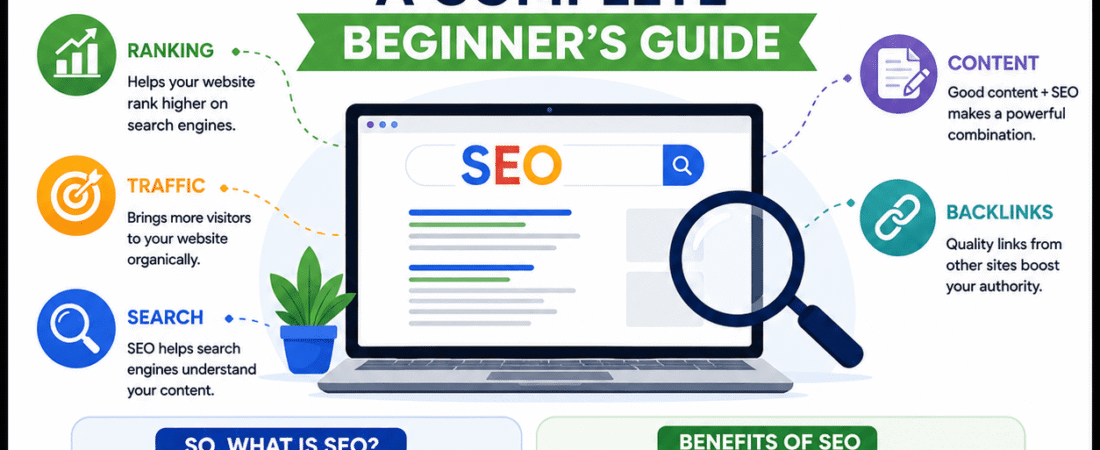
Here’s a complete beginner’s guide to SEO!
SEO (Search Engine Optimization) is the practice of improving your website so it ranks higher in search engine results — which means more people find you without you having to pay for ads. When someone Googles something and clicks a result that isn’t an ad, SEO is what put it there.
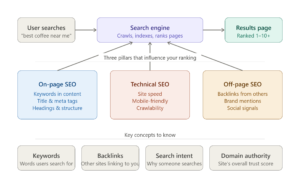
How search engines actually work
Before you can optimize anything, you need to understand what a search engine does:
- Crawling — Google sends bots (“spiders”) that visit web pages and follow links, discovering new content constantly.
- Indexing — Pages that pass quality checks get stored in Google’s massive index (essentially its database of the web).
- Ranking — When someone searches, Google’s algorithm picks the most relevant, trustworthy pages from its index and orders them.
Your job with SEO is to make sure your pages get crawled, indexed, and ranked as high as possible.
The three pillars
On-page SEO is everything you control directly on a page — using the right keywords in your headings, writing a clear title tag, crafting a compelling meta description, and structuring your content so it actually answers what the user is looking for.
Technical SEO is the behind-the-scenes stuff: how fast your site loads, whether it works on mobile, whether Google can even find and read your pages, and whether your URL structure makes sense. A technically broken site won’t rank no matter how good the content is.
Off-page SEO is your site’s reputation in the wider web. Backlinks — links from other reputable websites pointing to yours — are the biggest factor here. Google sees them as votes of confidence.
What Google actually rewards
Google’s algorithm has hundreds of signals, but a few fundamentals drive most of it:
- Relevance — Does your content genuinely answer the query?
- Quality — Is it well-written, accurate, and trustworthy? (Google calls this E-E-A-T: Experience, Expertise, Authoritativeness, Trustworthiness)
- User experience — Is the page fast, easy to navigate, and not cluttered with ads?
- Authority — Do other sites link to yours, and are those sites themselves trustworthy?
What to do first as a beginner
Start simple and build up:
- Keyword research — Find out what words and phrases people actually type to find things related to your topic. Free tools like Google Search Console or Keyword Planner help here.
- Write useful content — Create pages that fully answer a real question. Longer isn’t always better; more helpful is.
- Optimize your titles and headings — Make sure your target keyword appears naturally in your page title (the
<title>tag) and your main heading (H1). - Get your technical basics right — Ensure your site loads quickly, is mobile-friendly, and has clean URLs.
- Build links gradually — Reach out to related sites, write guest posts, or create content worth linking to.
What SEO is NOT
A few common misconceptions worth clearing up:
- It’s not instant — SEO typically takes 3–6 months to show meaningful results.
- It’s not a one-time fix — search algorithms update constantly, so SEO is ongoing.
- It’s not about tricking Google — tactics that try to “game” the algorithm (called “black hat SEO”) can get your site penalized. Sustainable SEO means genuinely being the best result.
Free tools to get started
| Tool | What it does |
|---|---|
| Google Search Console | Shows how Google sees your site, which queries you rank for, and errors |
| Google Analytics | Tracks where your traffic comes from |
| Ubersuggest / Ahrefs (free tier) | Keyword research and competitor analysis |
| PageSpeed Insights | Tests your site’s loading speed |
| Screaming Frog (free up to 500 URLs) | Crawls your site for technical issues |
SEO is a long game, but it compounds — a well-optimized site can bring in consistent, free traffic for years. The best starting point is always to write genuinely useful content for real people, not to chase an algorithm.