
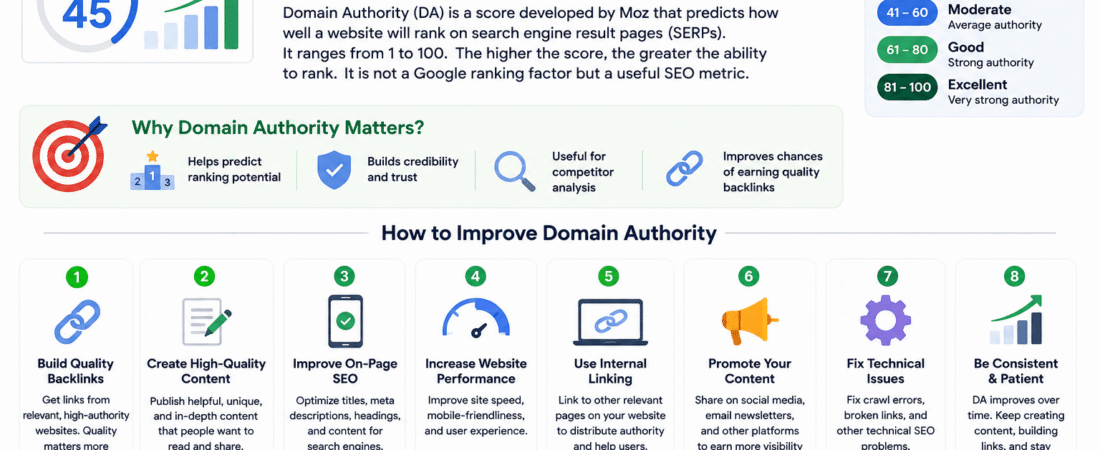
Domain Authority (DA) is a score — invented by SEO software company Moz — that predicts how likely a website is to rank in search results. It runs from 1 to 100: the higher the score, the stronger the site’s ranking potential.
A few important things to understand right away:
- Google does not use DA. It’s a third-party metric, not an official Google signal. Google has its own internal assessment of site authority, which it doesn’t publish.
- It’s relative, not absolute. A DA of 40 might be excellent in a niche industry but weak against major news sites (which often score 90+).
- It’s useful for comparison — comparing your site to competitors, or evaluating whether a potential link partner is worth pursuing.
Similar scores exist from other tools: Ahrefs calls it “Domain Rating” (DR), Semrush calls it “Authority Score.” They all measure roughly the same thing in slightly different ways.
What actually determines your DA score
DA is calculated primarily from your backlink profile — the number of backlinks pointing to your site, the authority of the sites those links come from, and the diversity of root domains linking to you. A single link from a high-DA site like a major newspaper is worth far more than dozens of links from obscure, low-quality sites.
Here’s a visual breakdown of the main factors:
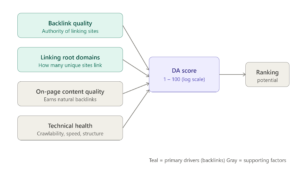
One thing worth knowing about the scale: DA grows logarithmically. Going from DA 10 to DA 30 is relatively achievable. Going from DA 60 to DA 80 is extremely hard, because you’re competing with massive, established websites. Don’t chase a high absolute number — focus on beating your direct competitors’ DA.
How to actually improve your DA
Everything comes back to earning better, more diverse backlinks. Here’s what moves the needle:
Create genuinely link-worthy content. The best long-term backlink strategy is producing content so useful that people link to it naturally — original research, comprehensive guides, free tools, data studies, or visual assets like infographics. If your content is a slightly rewritten version of what’s already out there, nobody will link to it.
Guest posting. Writing articles for reputable sites in your niche typically earns a backlink in your author bio or within the content itself. Focus on sites with real audiences, not low-quality “guest post farms” — Google has become very good at identifying and discounting those.
Broken link building. Find pages in your niche that have broken external links, then reach out to the site owner suggesting your content as a replacement. Tools like Ahrefs or Check My Links (a Chrome extension) can help find these opportunities.
Digital PR and media coverage. Getting mentioned or quoted in news articles, industry publications, or podcasts is one of the highest-quality ways to earn links. Sending expert commentary to journalists (via platforms like Help a Reporter Out) can land you on high-DA sites relatively quickly.
Reclaim unlinked mentions. Use Google Alerts or Ahrefs to find places that mention your brand name without linking to you. A polite outreach email asking them to add a link converts at a surprisingly high rate because they clearly already know who you are.
Fix toxic backlinks. Low-quality, spammy links from shady sites can actually hurt your DA. Use Google Search Console’s Disavow tool to tell Google to ignore them.
What not to do
Buying links is the most common DA-improvement mistake. Google’s guidelines explicitly prohibit paid links that pass PageRank, and penalties can tank your site’s visibility overnight. Similarly, link schemes (reciprocal “I link to you, you link to me” arrangements at scale) carry the same risk. The short-term DA bump isn’t worth it.
Realistic timelines
DA improvement is slow by nature. Most sites see meaningful movement over 6–12 months of consistent effort. Check your DA monthly (not daily — it updates infrequently), and measure it relative to competitors rather than as an isolated number. If your DA is 35 and your main competitor’s is 32, you’re already ahead where it counts.