
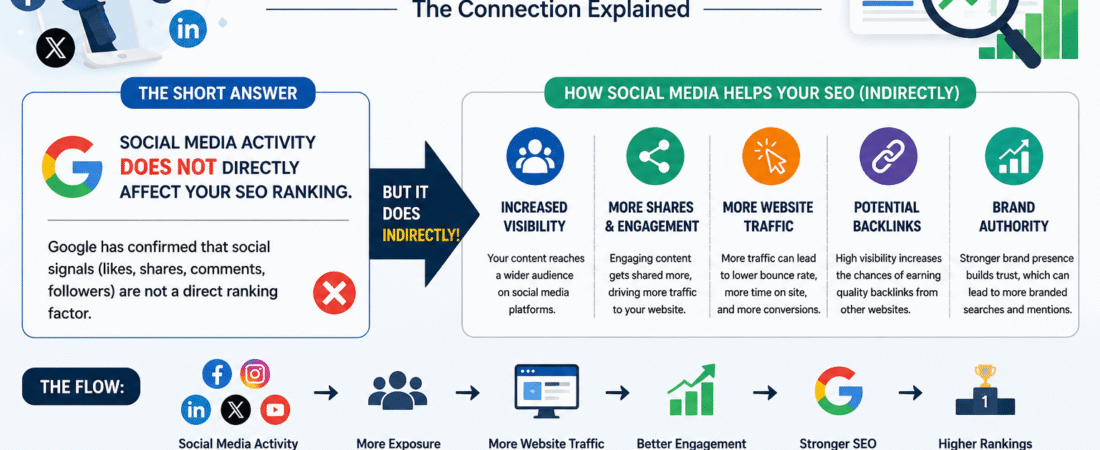
If you have spent more than five minutes browsing marketing blogs, you have probably run into a fierce debate: Does social media activity directly impact your Google search rankings? One camp argues that racking up thousands of likes, shares, and retweets sends direct signals to search engines that boost your domain authority. The other camp insists that social media is just a traffic driver and has zero algorithmic weight in search engine rankings.
The truth? It sits somewhere in the middle, but with a lot of nuance that most marketers overlook. Google’s official stance has remained consistent for years: social media links and shares are not direct ranking factors. However, to say social media has no effect on SEO is like saying a commercial trailer has nothing to do with whether people go see a movie. While the trailer itself doesn’t play inside the theater, it drives the audience through the doors.
Let’s break down the complex relationship between social media and search engine optimization, separate the myths from reality, and look at how you can leverage social platforms to indirectly supercharge your organic search visibility.
The Official Google Stance: Direct vs. Indirect SEO Signals
Let’s start with what Google’s search engineers have explicitly stated. Over the years, prominent Google spokespeople—most notably John Mueller—have addressed social signals repeatedly in Q&A sessions. The consensus is clear: Google does not crawl social media platforms the same way it crawls the traditional web. Because social networks are walled gardens, privacy settings change, and spam is rampant, Google treats social signals differently than standard backlinks.
When you publish a viral post on LinkedIn, Facebook, or X (formerly Twitter), Google does not look at the share count and say, “This post has 5,000 shares, let’s bump it up five spots on the SERP.” Social media links are traditionally treated as “nofollow” links, meaning they do not pass traditional PageRank.
Does this mean your social media strategy is useless for SEO? Absolutely not. While social signals are not direct ranking factors, they act as powerful indirect catalysts. Think of organic search and social media as two gears in a larger engine. One turns the other, creating momentum that ultimately pushes your website higher in search results.
How Social Media Indirectly Boosts Your SEO Performance
Even though a retweet won’t automatically hand you a number-one ranking, an active social media presence creates secondary effects that Google’s algorithm loves. Let’s look at the primary ways social activity influences your search rankings.
1. Amplified Content Distribution and Link Building
The core of modern SEO still relies on two fundamental pillars: high-quality content and authoritative backlinks. But here is the catch—great content doesn’t market itself. You can write the most comprehensive, meticulously researched guide on the internet, but if nobody sees it, nobody will link to it.
This is where social media shines. By promoting your latest blog post, infographic, or product page across your social channels, you get your content in front of industry peers, journalists, bloggers, and potential brand advocates. When someone with an established blog or news site sees your content on social media and loves it, they may link to it in their own articles. Those editorial backlinks are direct, heavyweight ranking factors.
2. Faster Indexing and Content Discovery
Google’s web crawlers are constantly scanning the web for new content, but they cannot be everywhere at once. When you publish a new page, it can sometimes take days or even weeks for Google to discover, crawl, and index it organically.
However, social media platforms are crawled by search engines almost continuously. When you share a new piece of content on high-authority platforms like LinkedIn, X, or YouTube, search engine bots often follow those links much faster than they would stumble across them through internal site navigation. While social sharing doesn’t replace an XML sitemap or proper technical SEO, it acts as a fast-pass ticket to getting your URLs noticed by search bots.
3. Brand Search Volume and Direct Traffic
Have you ever noticed that the top-ranking brands in any niche also happen to have massive social followings? That is not a coincidence. When people see your brand consistently on social media, they become familiar with your name. Eventually, instead of searching for generic keywords, they start searching for your brand name directly in Google (e.g., “best project management tool [Your Brand]”).
Google’s algorithm pays close attention to brand queries and direct traffic. High volumes of branded searches tell Google that your website is a trusted, authoritative entity in your industry. This halo effect lifts your rankings not just for branded terms, but for competitive, non-branded keywords as well.
4. Local SEO and Social Proof
If you run a local business—such as a restaurant, law firm, or retail storefront—social media plays a crucial role in your local SEO strategy. Platforms like Facebook, Instagram, and Yelp act as modern review hubs. Positive reviews, check-ins, and active community engagement signal to search engines that your business is active, legitimate, and trusted by local consumers.
Furthermore, Google often pulls user-generated content, images, and reviews directly from social platforms into local search packs and knowledge panels. Keeping your social profiles updated and active ensures that your local brand footprint remains robust across the entire web ecosystem.
Optimizing Social Profiles as Search Engines
Many digital marketers make the mistake of treating social media profiles as an afterthought. They throw up a logo, drop a link in the bio, and rarely update the page. In reality, modern social media platforms function as search engines in their own right. Gen Z and millennial consumers increasingly use TikTok, Instagram, and YouTube search bars instead of Google to find restaurants, product recommendations, and educational tutorials.
To maximize your total search visibility:
- Keyword-Optimize Your Bios: Include your primary target keywords in your social media bios, channel descriptions, and video captions so users can find you within platform-specific search engines.
- Build Omnipresence: Ensure your business name, address, phone number (NAP), and website URL are consistent across all social networks to strengthen your entity signals for Google.
- Repurpose Long-Form Content: Turn your in-depth blog posts into bite-sized Twitter threads, LinkedIn carousels, or Instagram reels, always driving traffic back to the original source article.
Ready to Dominate Search Engines and Social Media?
Navigating the complexities of search engine optimization and digital visibility can be overwhelming. Don’t leave your organic rankings to chance. Let our team of seasoned digital strategists audit your online presence, build high-impact authority, and drive targeted traffic to your website.
Conclusion: Bridging Social Media and SEO
To wrap things up, social media activity does not directly alter your search engine rankings through algorithmic shortcuts like share counts or follower metrics. However, it acts as a powerful amplifier for every core element that does matter to SEO—content distribution, link acquisition, brand awareness, user engagement, and faster indexing.
Instead of viewing SEO and social media marketing as two entirely separate departments, forward-thinking brands integrate them into a cohesive digital strategy. When you create phenomenal content, promote it aggressively across social channels, and cultivate a loyal online community, your search engine rankings will naturally rise as a rewarding byproduct.
Frequently Asked Questions
Do social media shares count as backlinks for SEO?
No. Most links from major social media platforms like Facebook, X, Instagram, and LinkedIn carry “nofollow” tags by default. This means they do not pass traditional PageRank or count as editorial backlinks in the eyes of search engine algorithms. However, they generate visibility that often leads to real, authoritative backlinks from other websites.
How long does it take for social media traffic to impact search rankings?
There is no direct timeline because social media does not cause an immediate algorithmic boost. However, if a piece of content goes viral on social media, you might see an uptick in organic search rankings within a few weeks due to increased brand searches, fresh referral traffic, and newly earned backlinks.
Should I focus on SEO or social media marketing first?
Ideally, you should invest in both simultaneously, as they support each other. If you are operating on a strict budget, many businesses start with foundational SEO to ensure their website is technically sound and optimized for high-intent keywords, then layer in social media to accelerate content distribution and brand growth.