
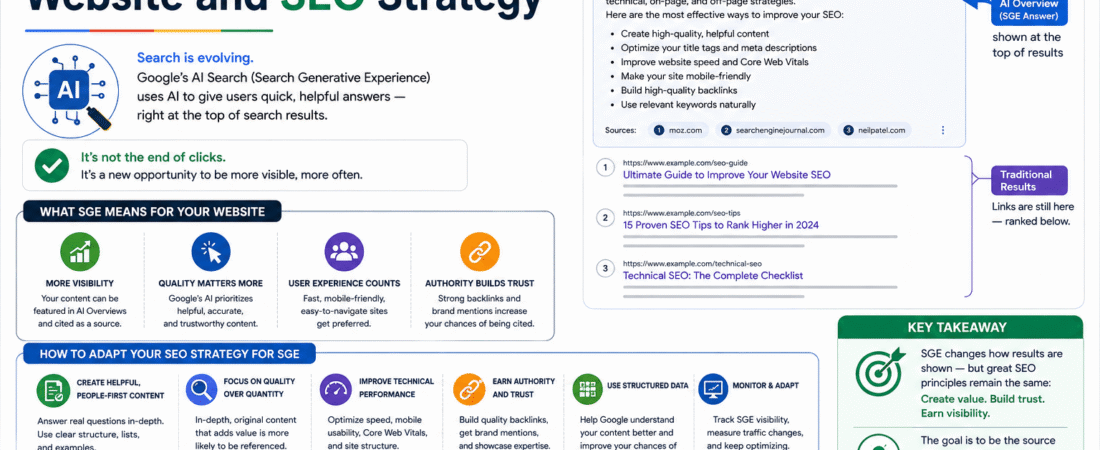
Search engines are changing faster than they have in two decades. If you have spent any time staring at Google lately, you have likely noticed that the traditional results page—the classic list of ten blue links—is sharing screen space with something entirely new. AI-powered summaries, conversational answer boxes, and synthesized snapshots now sit right at the top of the page. This shift, driven by Google’s generative AI technology, is reshaping how people find information online.
For website owners, business leaders, and digital marketers, this is a massive moment. When Google answers user questions directly in an AI-generated box, what happens to your organic traffic? Do traditional search rankings still matter? How do you adapt your content strategy so your brand is cited as the source rather than bypassed altogether?
We are going to break down everything you need to know about Google’s AI Search experience, how it impacts your visibility, and the exact steps you need to take to protect and grow your digital presence.
What Is Google’s AI Search Experience?
To understand where search is going, it helps to understand what Google is trying to achieve. For years, Google’s job was to act as a matchmaker. You typed a query, and Google found the best pages that contained the answer. You clicked a link, visited a website, and hunted for the information yourself.
With generative search, Google is evolving from a matchmaker into a research assistant. Instead of just pointing you to websites, Google reads multiple sources, synthesizes the information, and writes a cohesive, conversational summary right at the top of the search engine results page (SERP). It can answer complex, multi-part questions, offer follow-up prompts, and pull data from across the web into a single snapshot.
For example, if you search for “best lightweight backpacking tent for rainy conditions under $300,” Google’s AI doesn’t just give you a list of review sites. It generates a summary comparing key features, weights, and water resistance ratings of top models, complete with source links embedded directly into the text. Users get their answer instantly without ever scrolling down.
The Direct Impact on Website Traffic and Organic CTR
The elephant in the room for every business owner is traffic. If Google answers the user’s question on the search page, why would anyone click through to your website?
The reality is nuanced. Websites that rely heavily on answering simple informational queries—such as basic definitions, quick how-to steps, or factual lookups—are seeing a dip in click-through rates. When Google provides the definition of a term right in the AI box, users have no reason to visit the site that originally published that definition.
However, this does not mean SEO is dead. It means the nature of search intent is evolving:
- Informational queries are becoming zero-click: Users get quick answers directly from the AI snapshot.
- Commercial and transactional queries require deeper research: When people are ready to buy, compare products in depth, or hire a service provider, they still want to read reviews, explore case studies, and evaluate brands thoroughly.
- Citation value is replacing ranking value: Being cited as a trusted source inside the AI summary drives high-intent, highly qualified traffic to your pages.
The goal is no longer just ranking in the top three positions. The new goal is to become the trusted authority that the AI relies upon to build its answers.
How to Optimize Your Website for Google’s AI Search
Adapting your website to thrive in an AI-driven search landscape requires a shift in mindset. You cannot just optimize for keywords anymore; you must optimize for authority, structure, and context. Here is how you can future-proof your digital strategy:
1. Focus on Deep, First-Hand Experience and Expertise
Google’s AI models are trained to prioritize high-quality, reliable information. Content that feels generic, recycled, or artificially generated by cheap tools will struggle to gain traction. To stand out, your content must offer genuine expertise, original research, expert commentary, and real-world case studies.
Ask yourself: Does this page offer something unique that an AI cannot easily synthesize from public web data? If your content is just a compilation of other people’s blog posts, the AI will bypass you and aggregate the data itself. If your content features proprietary insights, expert interviews, or hands-on testing, Google’s systems are far more likely to cite your URL.
2. Master Structured Data and Technical SEO
AI search engines rely heavily on machine-readable data to understand context. If your website’s technical foundation is messy, the AI will struggle to parse your content accurately.
Implementing comprehensive schema markup is non-negotiable. Use product schema, FAQ schema, author schema, and organizational schema to explicitly tell search engines what your content is about, who wrote it, and how it is structured. Clean code makes it effortless for Google’s crawlers to extract and attribute your content correctly.
3. Target Complex, Multi-Intent Keywords
Since Google’s AI handles simple questions easily, you should pivot your keyword strategy toward queries that require deeper context, nuance, or human experience. Focus on long-tail search phrases, comparative analysis, industry-specific challenges, and localized service intent.
Create comprehensive resource hubs that answer related follow-up questions naturally within the same page. By addressing the entire user journey from discovery to decision-making, you capture attention even when users want to dive deeper than a simple summary allows.
4. Build Brand Authority Across the Web
Google’s AI does not just look at your website in isolation; it looks at your brand’s digital footprint across the entire internet. Mentions on industry podcasts, guest articles on reputable publications, positive customer reviews, and active social profiles all contribute to your overall brand entity authority.
When Google’s AI evaluates who to trust for a specific niche, it looks for consensus across trusted web domains. Building a robust off-page presence ensures that search engines recognize your brand as an industry leader.
Ready to Future-Proof Your Organic Growth?
Navigating Google’s AI search updates can feel overwhelming, but you don’t have to figure it out alone. Let our team of organic search experts audit your current visibility, identify AI-driven opportunities, and position your brand for long-term dominance.
Looking Ahead: The Evolution of Search
The integration of artificial intelligence into search engines is not a temporary trend; it is the permanent future of how humans discover information online. While the rules of the game are shifting, the core principle of great digital marketing remains unchanged: create exceptional, trustworthy content that genuinely helps your audience solve their problems.
Businesses that embrace this shift by refining their technical architecture, doubling down on original expertise, and optimizing for brand authority will capture more qualified market share than ever before. The websites that suffer will be the ones clinging to outdated keyword-stuffing tactics and superficial content.
Now is the time to evaluate your digital strategy, audit your existing content portfolio, and align your marketing efforts with the realities of modern search engine algorithms.
Frequently Asked Questions
Is traditional SEO dead because of Google’s AI search?
No, traditional SEO is not dead, but it is evolving rapidly. While basic informational keywords may see lower click-through rates as Google answers questions directly in AI summaries, technical optimization, content authority, and user experience remain critical for ranking and earning citations within those AI snapshots.
How can my website get cited in Google’s AI search results?
To increase your chances of being cited as a source in Google’s AI summaries, you need to publish high-authority, original content that demonstrates first-hand expertise. Additionally, maintaining a strong technical foundation with clean schema markup and building solid brand recognition across the web helps search engines trust your domain.
How long does it take to adapt an SEO strategy for AI search?
Adapting your digital strategy is an ongoing process rather than a one-time fix. Conducting a comprehensive content and technical audit typically takes a few weeks, while implementing structural changes, improving content depth, and building authority can take anywhere from three to six months to show measurable impact in organic visibility.