
Basics
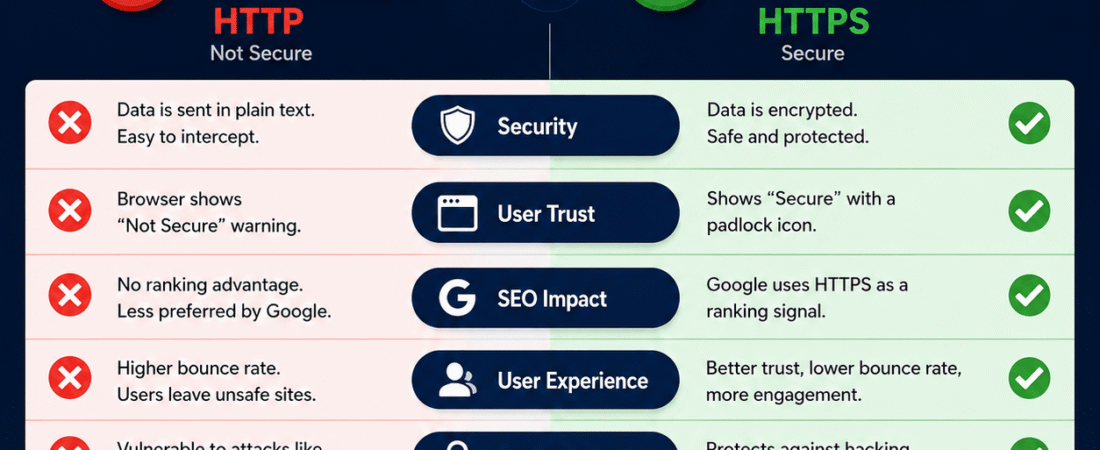
HTTP (Hypertext Transfer Protocol) and HTTPS (Hypertext Transfer Protocol Secure) are both protocols used to transfer data between a user’s browser and a website’s server. The core difference is encryption: HTTPS encrypts the data exchanged using SSL/TLS (Secure Sockets Layer/Transport Layer Security), while HTTP sends data in plain text. This means that with HTTP, anyone intercepting the connection — on public Wi-Fi, through an ISP, or via a man-in-the-middle attack — can read or even alter the data being transmitted. HTTPS prevents this by encrypting the connection, verifying the identity of the website through an SSL certificate, and ensuring data integrity.
While this sounds like a purely technical or security-related distinction, it has become deeply intertwined with search engine optimization over the past decade, and understanding why is essential for anyone managing a website’s visibility in search results.
HTTPS as a Confirmed Google Ranking Signal
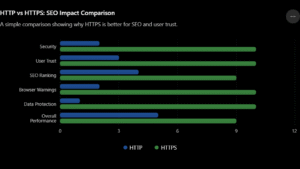
In August 2014, Google officially announced that HTTPS would be used as a ranking signal, encouraging website owners to switch from HTTP to HTTPS. At the time, Google described it as a “lightweight” signal, carrying less weight than factors like content quality or backlinks, but affecting fewer than 1% of global queries. However, Google was explicit that this weighting could increase over time as adoption grew, and it has: as HTTPS became the norm across the web, sites still running on HTTP increasingly stand out as outliers, and outliers in security tend to be penalized both algorithmically and through user trust signals.
Today, HTTPS is essentially table stakes. It’s not going to catapult a mediocre site to the top of search results, but running an unsecured HTTP site can actively hold you back, especially when competitors in your niche have already made the switch. Google has repeatedly framed HTTPS as part of a broader “safe browsing” initiative, and search rankings are just one piece of a larger ecosystem where HTTPS matters.
Direct SEO Impacts
1. Ranking Signal As mentioned, HTTPS is a confirmed (if minor on its own) ranking factor. When two pages are otherwise similar in quality, relevance, and authority, the HTTPS version has an edge. This matters more in competitive niches where marginal differences decide rankings.
2. Browser Warnings and Bounce Rate Since 2018, Chrome (and other major browsers) mark HTTP sites as “Not Secure” directly in the address bar, especially on pages with forms, login fields, or payment information. This warning creates immediate distrust. Users who see “Not Secure” are far more likely to leave the site instantly, increasing bounce rate. Bounce rate and dwell time are behavioral signals that, while not officially confirmed as direct ranking factors by Google, are widely believed to influence rankings indirectly — search engines interpret quick exits as a sign that the page failed to satisfy user intent, which can suppress rankings over time.
3. Data Integrity for Analytics HTTPS also affects referral data accuracy. When a user clicks from an HTTPS site to an HTTP site, referral information is often stripped and shows up as “direct traffic” in analytics tools rather than attributing it to the correct source. This doesn’t affect rankings directly, but it distorts your ability to measure and optimize your SEO efforts — you lose visibility into which channels are actually driving traffic, making it harder to double down on what’s working.
4. Mixed Content Issues Websites that migrate to HTTPS but still load some resources (images, scripts, stylesheets) over HTTP create “mixed content” warnings. Browsers may block these insecure resources entirely, breaking page functionality or design, which harms user experience — and user experience metrics (page speed, layout stability, interactivity) are core parts of Google’s Core Web Vitals, which are an explicit part of the ranking algorithm.
5. AMP and Progressive Web App Requirements Historically, features like Accelerated Mobile Pages (AMP) required HTTPS to function at all. While AMP’s prominence has diminished, several modern web technologies and browser APIs (like service workers, geolocation, and push notifications) require a secure context (HTTPS) to work. If your SEO strategy depends on modern web features for engagement or mobile performance, HTTPS is a prerequisite, not an option.
6. Trust Signals and E-E-A-T Google’s quality guidelines emphasize E-E-A-T (Experience, Expertise, Authoritativeness, Trustworthiness), particularly for YMYL (Your Money or Your Life) content — sites dealing with health, finance, legal, or safety information. While HTTPS alone doesn’t make a site “trustworthy” in Google’s eyes, it’s considered a baseline trust signal. A YMYL site running on HTTP, especially one collecting any personal or payment data, signals a lack of care about user safety, which can undermine perceived trustworthiness — a factor human quality raters are explicitly instructed to consider.
The Indirect but Real Impacts
Beyond the direct technical and algorithmic effects, HTTPS influences SEO indirectly through user behavior and business outcomes:
- Conversion rates: Users are less likely to complete purchases, sign-ups, or form submissions on a site flagged as insecure, particularly for anything involving payment or personal information.
- Backlink acquisition: Other reputable websites are less likely to link to an HTTP site, both because of trust concerns and because many editorial and PR outlets have policies against linking to insecure domains. Since backlinks remain one of the strongest ranking factors, this indirectly suppresses HTTP sites’ authority growth.
- Social sharing: Some social platforms and referral sources deprioritize or flag insecure links, reducing the organic reach of shared content.
Migration Considerations (and Risks of Doing It Wrong)
Switching from HTTP to HTTPS is generally beneficial, but a poorly executed migration can temporarily hurt SEO. Key steps to avoid pitfalls include:
- Obtain and install an SSL/TLS certificate from a trusted certificate authority (many hosts now offer free certificates via Let’s Encrypt).
- Set up 301 redirects from every HTTP URL to its HTTPS equivalent. This preserves link equity and tells search engines the move is permanent, not just a duplicate content situation.
- Update internal links throughout the site to point directly to HTTPS URLs rather than relying solely on redirects, which improves crawl efficiency and load speed.
- Update your XML sitemap and robots.txt to reference the HTTPS versions of your pages.
- Update canonical tags to point to HTTPS URLs, preventing search engines from indexing both versions as duplicates.
- Reconfigure Google Search Console and Analytics for the new HTTPS property, since Google treats HTTP and HTTPS versions of a domain as separate properties.
- Fix mixed content warnings by ensuring all resources (scripts, images, fonts, embeds) load via HTTPS.
- Update external backlinks where possible — while redirects handle this automatically, reaching out to high-value linking sites to update their links directly preserves more link equity and avoids redirect chains.
Skipping or mishandling any of these steps can cause temporary ranking volatility, broken pages, or lost link equity, which is why some site owners mistakenly believe “HTTPS hurt my rankings” when in reality a flawed migration process was the culprit.
Bottom Line
HTTPS itself is not a magic bullet for SEO — it won’t outweigh poor content, weak backlink profiles, or bad site architecture. But it functions as a baseline requirement in modern search: a small but real ranking signal, a major factor in user trust and behavioral metrics, a prerequisite for certain modern web technologies, and an increasingly assumed standard across the web. Running HTTP in 2026 isn’t just an SEO liability — it’s a user experience and security liability that compounds over time as browsers, users, and search engines alike treat unencrypted sites with growing suspicion. For any site serious about long-term organic visibility, HTTPS isn’t optional; it’s foundational infrastructure that every other SEO effort builds on top of.