
On-page SEO — what you own
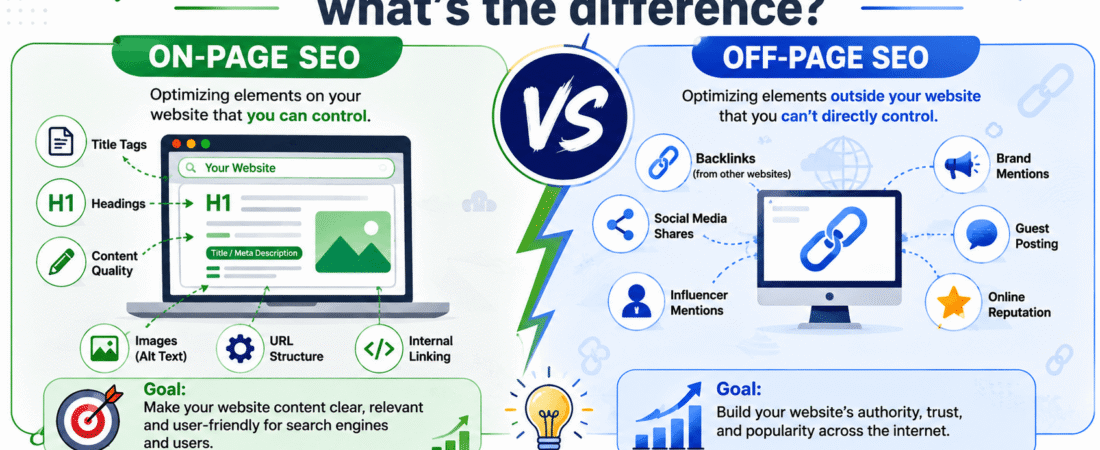
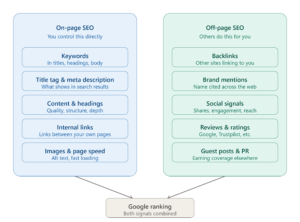
On-page SEO covers everything you can edit directly on your website. The key idea is relevance — you’re telling Google exactly what each page is about and proving it’s useful.
The most important on-page elements:
Title tag — the clickable blue headline that appears in search results. It should include your target keyword and be compelling enough to earn the click. Keep it under ~60 characters.
Meta description — the short summary beneath the title in search results. Google doesn’t use it as a ranking signal directly, but a well-written one improves click-through rates, which matters.
Headings (H1, H2, H3) — your H1 is the main topic of the page; only use one. Subheadings (H2, H3) help structure the content and naturally include related keywords.
Content quality — Google rewards pages that genuinely and thoroughly answer the query. Thin, vague, or copied content won’t rank. Aim to be the most useful result on a topic.
Internal links — linking from one of your pages to another helps Google understand your site’s structure and spreads “link value” across your pages.
Images — use descriptive alt text (Google can’t see images, but it reads alt text), and compress images so pages load fast.
Off-page SEO — your reputation
Off-page SEO is about building trust and authority in the eyes of Google — and it comes mostly from other people and websites, not you.
Backlinks are the backbone. When a reputable website links to yours, Google treats it like a vote of confidence. Not all links are equal — a link from a major news site or a respected industry blog is worth far more than a link from a random directory. Quality beats quantity here.
Brand mentions — even without a link, Google notices when your brand name appears across the web. It’s a weaker signal, but it contributes to overall authority.
Reviews — especially for local businesses, Google reviews directly influence rankings in local search. More (genuine) positive reviews = better local visibility.
Guest posting and PR — writing articles for other sites or earning media coverage gets your name in front of new audiences and typically earns backlinks.
The key difference in a nutshell
| On-page | Off-page | |
|---|---|---|
| Who controls it | You | Others (mostly) |
| Main signal | Relevance | Authority / trust |
| Time to impact | Faster (days–weeks) | Slower (weeks–months) |
| Where to start | Always start here | Build once on-page is solid |
You need both. A site with great content but no backlinks will struggle to rank for competitive terms. A site with lots of backlinks but poor content won’t convert visitors or hold rankings. The winning formula is always: get the on-page fundamentals right first, then build off-page authority over time.