
Definition
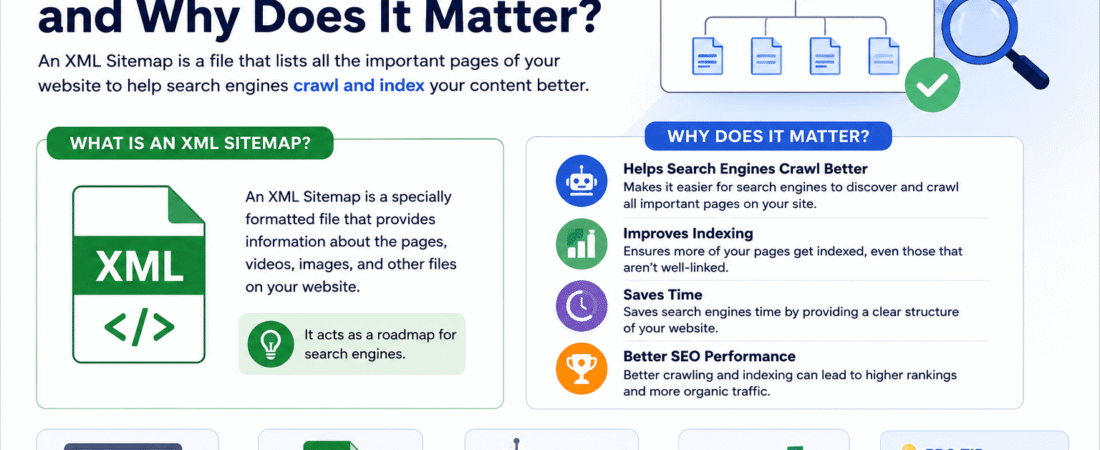
An XML sitemap is a structured file, written in Extensible Markup Language (XML), that lists the URLs of a website along with optional metadata about each URL — such as when it was last updated, how frequently it changes, and its relative importance compared to other pages on the site. Think of it as a roadmap or table of contents that you hand directly to search engines, rather than hoping they stumble upon every page on their own through link-following.
The format was introduced by Google in 2005 and was later adopted jointly by Google, Yahoo, and Microsoft (Bing) as a shared standard under the sitemaps.org protocol. Since then, it has become one of the most fundamental technical SEO tools available to website owners.
A typical XML sitemap file looks something like this:
<?xml version="1.0" encoding="UTF-8"?>
<urlset xmlns="http://www.sitemaps.org/schemas/sitemap/0.9">
  <url>
    <loc>https://www.example.com/</loc>
    <lastmod>2026-07-15</lastmod>
    <changefreq>weekly</changefreq>
    <priority>1.0</priority>
  </url>
  <url>
    <loc>https://www.example.com/products</loc>
    <lastmod>2026-07-10</lastmod>
    <changefreq>daily</changefreq>
    <priority>0.8</priority>
  </url>
</urlset>
Each <url> block represents one page, with <loc> being the only required tag (the page’s location/URL). The other tags — lastmod, changefreq, and priority — are optional hints, and search engines treat them with varying degrees of trust (more on that below).
How XML Sitemaps Work
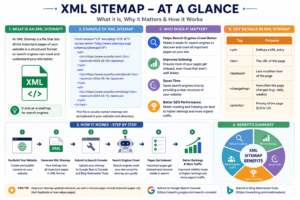
Search engines discover content in two primary ways: by crawling links from page to page across the web, and by reading sitemaps that site owners submit directly. When Googlebot, Bingbot, or another crawler visits a sitemap, it gets a clean, explicit list of URLs the site owner wants indexed. This doesn’t guarantee indexing — search engines still evaluate each page’s quality, uniqueness, and relevance — but it dramatically improves the odds that a page will be found in the first place.
Sitemaps are typically placed at a predictable location, like https://www.example.com/sitemap.xml, and referenced in two additional places:
- The robots.txt file — a line like
Sitemap: https://www.example.com/sitemap.xmltells any crawler that respects robots.txt where to find it. - Search engine tools directly — site owners can manually submit sitemaps through Google Search Console and Bing Webmaster Tools.
For very large websites, a single sitemap file isn’t enough (each sitemap file is capped at 50,000 URLs and 50MB uncompressed). In these cases, sites use a sitemap index file — essentially a sitemap of sitemaps — which points to multiple individual sitemap files, often segmented by content type (e.g., sitemap-products.xml, sitemap-blog.xml, sitemap-categories.xml).
Why XML Sitemaps Matter
1. Improved Crawl Efficiency and Discovery
Search engines allocate a limited “crawl budget” to each site — a rough allowance of how many pages they’ll crawl within a given timeframe. This is especially relevant for large sites with thousands or millions of pages. A well-structured sitemap helps crawlers spend that budget efficiently by pointing them straight to the pages that matter, rather than forcing them to discover everything through internal link-following, which can be slow, incomplete, or inconsistent.
This is particularly important for:
- New websites with few external backlinks pointing to them (so crawlers have fewer natural entry points).
- Large e-commerce sites with deep catalogs, many of which may only be reachable through several link clicks from the homepage.
- Sites with poor internal linking structures, where some pages are “orphaned” (not linked to from anywhere else on the site).
2. Faster Indexing of New or Updated Content
When you publish a new blog post or update an existing page, you generally want search engines to notice quickly — especially for time-sensitive content like news articles. Including accurate lastmod dates in your sitemap can help search engines prioritize recrawling recently changed pages, which can shorten the gap between publishing and appearing in search results.
3. Communicating Site Structure and Priority
While Google has stated that the priority and changefreq tags carry relatively little weight in modern ranking and crawling decisions (Google’s own documentation notes it largely ignores these), the sitemap as a whole still communicates structure. It tells search engines which URLs the site owner considers canonical and worth indexing, which is valuable signal amid a web full of duplicate content, parameterized URLs, and staging pages that shouldn’t be indexed.
4. Surfacing Pages Not Well-Linked Internally
Not every important page sits within easy reach of a site’s main navigation. Pages like older archive content, seasonal landing pages, or deeply nested category pages might lack strong internal linking. A sitemap acts as a safety net, ensuring these pages are still visible to crawlers even if your site architecture isn’t perfect.
5. Supporting Non-HTML Content
Beyond standard web pages, there are specialized sitemap formats for:
- Images (helping Google Images discover and index visual content)
- Videos (providing metadata like duration, thumbnail, and description for video search)
- News (a stricter, faster-refreshing format for Google News eligibility)
These specialized sitemaps extend the core benefit — better discovery — into content types that aren’t just plain text pages.
6. Diagnostic and Monitoring Value
Once submitted through tools like Google Search Console, sitemaps become a diagnostic asset. Search Console will report how many submitted URLs were actually indexed versus excluded, and often explains why (duplicate content, noindex tags, crawl errors, etc.). This turns your sitemap into an ongoing feedback loop: you can track indexing coverage over time and catch technical issues — like accidentally blocked pages or broken URLs — before they cause significant traffic loss.
Common Misconceptions
It’s worth being clear about what an XML sitemap does not do:
- It does not guarantee indexing. Submitting a URL in a sitemap is a suggestion, not a command. Search engines still apply their own quality and relevance filters.
- It does not directly boost rankings. A sitemap helps with discovery and crawling, not with the ranking algorithm itself. Good content, backlinks, and on-page optimization still do the heavy lifting for rankings.
- It should not include pages you don’t want indexed. Including low-value, duplicate, or noindexed pages in a sitemap can actually create confusing signals and waste crawl budget.
When XML Sitemaps Matter Most
While every site can benefit from having one, XML sitemaps become especially critical for:
- Large websites (thousands+ pages)
- New websites without an established backlink profile
- Sites with frequently updated content (news, blogs, e-commerce inventory)
- Sites with complex navigation or JavaScript-heavy architectures where crawlers may struggle to follow links naturally
- Sites recovering from a redesign, migration, or restructuring, where the URL landscape has changed significantly
Best Practices Summary
- Keep the sitemap updated automatically (most CMS platforms like WordPress, Shopify, and Webflow generate and update sitemaps dynamically).
- Only include canonical, indexable URLs (avoid redirects, 404s, noindexed pages, or duplicate parameter variants).
- Keep individual sitemap files under the 50,000 URL / 50MB limits, using a sitemap index for larger sites.
- Reference the sitemap in your robots.txt file.
- Submit the sitemap manually through Google Search Console and Bing Webmaster Tools for visibility into indexing status.
- Use accurate
lastmodvalues — inaccurate or constantly-changing dates can cause search engines to reduce trust in that signal over time.
Conclusion
An XML sitemap is a small technical file with an outsized role in how efficiently and completely a website gets discovered by search engines. It doesn’t replace good site architecture, internal linking, or content quality — but it acts as a direct communication channel to crawlers, reducing ambiguity about which pages exist and matter. For any site beyond a handful of pages, maintaining an accurate, up-to-date XML sitemap is considered a baseline technical SEO practice rather than an optional extra.